Main Goal:
- Provide a structured, multi-disciplinary path for students to evolve from Foundational Engineers to Robotics Scientists.
- Bridge the gap between low-level hardware/dynamics and high-level AI/Research.
I. The 4-Year Evolution
Robotics isn’t just about making things move; it’s about the convergence of perception, planning, and control. This roadmap breaks down that journey into four distinct layers of expertise.
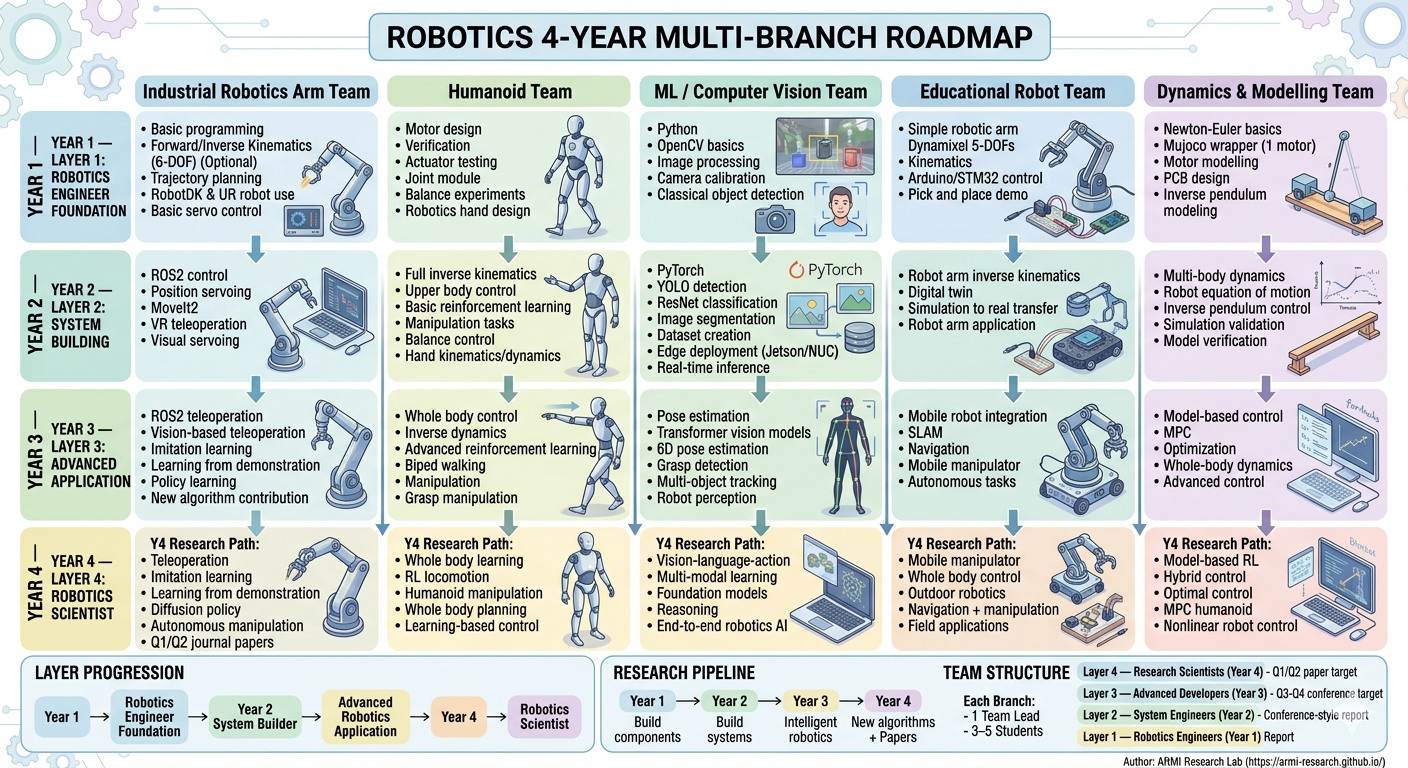
| Year | Layer | Role | Focus |
|---|---|---|---|
| Year 1 | Layer 1 | Foundation | Building components, basic programming, and fundamental physics. |
| Year 2 | Layer 2 | System Building | Integrating components into functional systems (ROS2, digital twins). |
| Year 3 | Layer 3 | Advanced Application | Intelligent robotics, SLAM, and Learning from Demonstration (LfD). |
| Year 4 | Layer 4 | Robotics Scientist | Contributing new algorithms and publishing Q1/Q2 journal papers. |
II. Specialized Research Tracks
Depending on your interest, your path will diverge into one of five core specializations. While the foundational math remains the same, the tools and targets differ significantly.
1. Industrial Robotics Arm Team
Focused on precision and automation.
- Start: Forward/Inverse Kinematics and RobotDK.
- End: Diffusion policies, autonomous manipulation, and advanced teleoperation.
2. Humanoid Team
The pinnacle of mechanical complexity.
- Start: Motor design, joint modules, and balance experiments.
- End: RL locomotion, whole-body planning, and humanoid manipulation.
3. ML / Computer Vision Team
The “eyes” and “brain” of the robot.
- Start: OpenCV, camera calibration, and classical object detection.
- End: Foundation models, reasoning, and Vision-Language-Action (VLA) models.
4. Educational Robot Team
Focus on accessibility and mobile integration.
- Start: Arduino/STM32, Dynamixel control, and pick-and-place.
- End: Outdoor robotics, field applications, and mobile manipulation.
5. Dynamics & Modelling Team
The mathematical backbone of stability.
- Start: Newton-Euler basics, Mujoco simulation, and Inverse Pendulums.
- End: Model-based RL, Hybrid/Optimal control, and non-linear robot control.
III. The Research Pipeline
Transitioning from an engineer to a scientist requires a shift in mindset. You move from “How do I build this?” to “How do I improve the state-of-the-art?”
- Year 1 (Build Components): Focus on the “What.” Learn the hardware and the basic code.
- Year 2 (Build Systems): Focus on the “How.” Implement ROS2 and verify models in simulation.
- Year 3 (Intelligent Robotics): Focus on the “Why.” Apply advanced algorithms like MPC and SLAM.
- Year 4 (New Algorithms + Papers): The final frontier. Research scientists focus on original contribution and high-impact publications.
IV. Team Structure & Targets
To maintain a high-velocity research lab, a hierarchical structure is recommended:
- Layer 4 (Year 4): Research Scientists. Target: Q1/Q2 Journal Papers.
- Layer 3 (Year 3): Advanced Developers. Target: Q3-Q4 Conference Papers.
- Layer 2 (Year 2): System Engineers. Target: Conference-style Reports.
- Layer 1 (Year 1): Robotics Engineers. Target: Foundational Reports.
A Note to Students: Don’t be intimidated by the Year 4 requirements. Everyone starts by fighting with an Arduino or a basic kinematics equation. The goal is consistent progression. If you’re currently in Year 1, focus on mastering the 6-DOF math—it’s the foundation for everything that follows.
Happy Researching! 🤖🚀
``` _